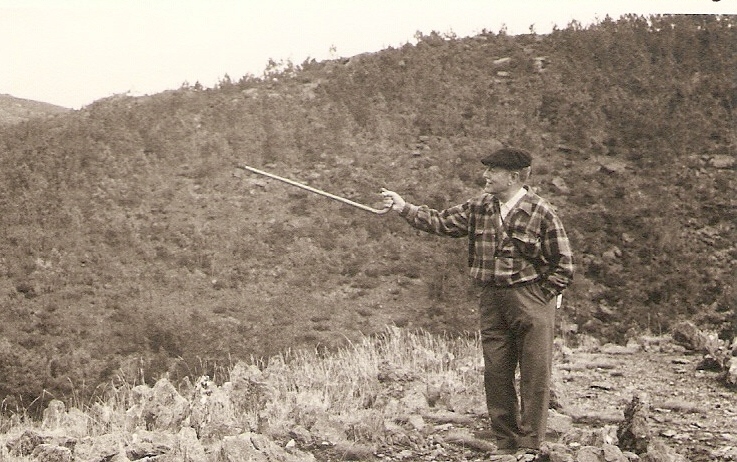

Joaquim dos Santos Júnior was a Portuguese doctor, anthropologist, ornithologist and university professor, born in Barcelos at the beginning of the 20th century, specifically on May 2, 1901.
He completed most of his education in Porto, attending secondary school there from 1911 to 1918. After completing this stage, he began studying Agricultural Engineering at the University of Lisbon, but had to interrupt his studies for health reasons. He later returned to Porto, where he graduated in Historical and Natural Sciences in 1923. He complemented his education with studies in Greek, Ethnology, Aesthetics and Art History. Later, he specialised in Colloidal Chemistry, graduated in Medicine and Surgery and, in 1944, obtained his doctorate with a thesis on the anthropology of Mozambique.
He began his professional career in 1923 as an assistant at the Faculty of Sciences of the University of Porto, where he taught various subjects over several decades, such as Zoology, Anthropology, Animal Ecology, Comparative Anatomy and Physiology, and later Sociology. He progressively advanced in his career until being promoted to full professor in 1954. He also held management positions in scientific institutions at the university, including the Anthropological Museum and Laboratory and the Dr Augusto Nobre Institute of Zoology and Marine Zoology Station.
Alongside his academic work, he practised medicine at Hospital de Santo António, taking part in scientific missions, notably as head of the Anthropological Mission of Mozambique, with six campaigns carried out between 1936 and 1956. He was also a visiting professor at the University of Luanda, where he taught zoology until his retirement in 1971.
He was well-known in the scientific fields of ethnography, anthropology, and archaeology, having published extensively in these areas, as well as on prehistory and zoology. He was one of the pioneers in research on the Portuguese overseas territories and participated in numerous conferences in Europe and Mozambique. In ornithology, he pioneered the scientific ringing of birds in Portugal and promoted the creation of the Mindelo Ornithological Reserve (Vila do Conde).
In Caldas Santas de Carvalhelhos (Boticas), a thermal spa he frequented relatively assiduously for rest and treatment, he discovered the Castro de Carvalhelhos, whose excavations he directed. His relationship with Barroso also intensified with the direction of excavations and study of the Castro de S. Vicente da Chã, in Montalegre. Similarly, he wholeheartedly dedicated himself to archaeological studies in various regions of Trás-os-Montes, excavating hillforts and publishing his findings.
He lived most of his life in the town of Maia, at Quinta da Caverneira – a 19th-century building – and died in 1990, in Águas Santas. After his death, the Municipal Library of Torre de Moncorvo (where he used to spend his holidays, on his wife’s property) received his estate.